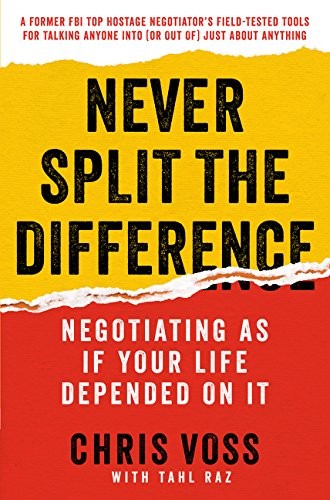
Never Split the Difference
by Chris Voss with Tahl Raz
OUR INSIGHT
This book, written by a former FBI hostage negotiator, argues that negotiation isn't a battle of logic but a conversation about emotion. Its central claim is that people aren't rational in the way most negotiation training assumes; they're driven by fear, need, and the feeling of being understood. The techniques it teaches — labeling emotions, mirroring words, asking calibrated questions, and embracing silence — are all aimed at making the other person feel heard, because a person who feels understood becomes far more flexible. The book pushes back against the idea that empathy is soft; it argues that tactical empathy is one of the most powerful tools in any high-stakes conversation. For someone building a process, the lesson is that the hardest conversations — whether in business or in life — are rarely won by the cleverest argument. They're won by the person who can stay calm, listen carefully, and make the other side feel safe enough to move.
5 IDEAS TO TAKE WITH YOU
5 Ideas to Take With You
- 01
Listen for the emotion
People decide based on feeling and justify with logic. Reading the emotion matters more than perfecting the argument.
- 02
Label what they feel
Naming someone's emotion — 'it sounds like you're worried' — makes them feel seen and lowers their defenses.
- 03
Mirror and pause
Repeating their last words and then staying silent pulls more information out than any question.
- 04
Ask calibrated questions
'How' and 'what' questions make the other side solve your problem with you, instead of resisting you.
- 05
Tactical empathy
Understanding isn't agreement. Genuine empathy, used deliberately, is what makes people flexible.
MAKE IT PERSONAL
Make It Personal
The lesson becomes more powerful when you connect it to your own life.
In your last difficult conversation, were you focused on being right — or on understanding what the other person actually needed?
Where do you tend to argue with logic when the real barrier is an emotion you haven't acknowledged?
What is one upcoming conversation where you could practice labeling the other person's feeling before making your point?
START TODAY
In your next conversation, mirror the other person's last few words and then let silence sit. Notice what they reveal.
CONTINUE YOUR PROCESS
Continue Your Process
RELATED BOOKS

Book & Copyright Notice
Trust the Process does not provide, reproduce, or distribute the complete book through this website. The material on this page is independent educational commentary and reflection created to help visitors explore ideas related to the book. Book titles, cover artwork, author names, trademarks, and other protected materials remain the property of their respective rights holders. This page is not intended to replace the original work. To read the complete book, please obtain or access it through an authorized retailer, publisher, library, or other legitimate source.
Don't Just Read It. Apply It.
Choose one lesson. Answer one question. Take one action today.
Because knowing the lesson isn't the process. Living it is.
Watching someone else’s journey is only the beginning.
Every story has a process. Now it’s time to build yours. Take what you’ve learned, turn it into action, and start creating meaningful progress in your own life.
Enter Build the ProcessYour journey starts here
Turn inspiration into action.
Build the Process
Learn. Reflect. Take action. Build your process.
- Learn from real stories
- Get practical takeaways
- Take action in your life
- Track your progress
- Build a more intentional future